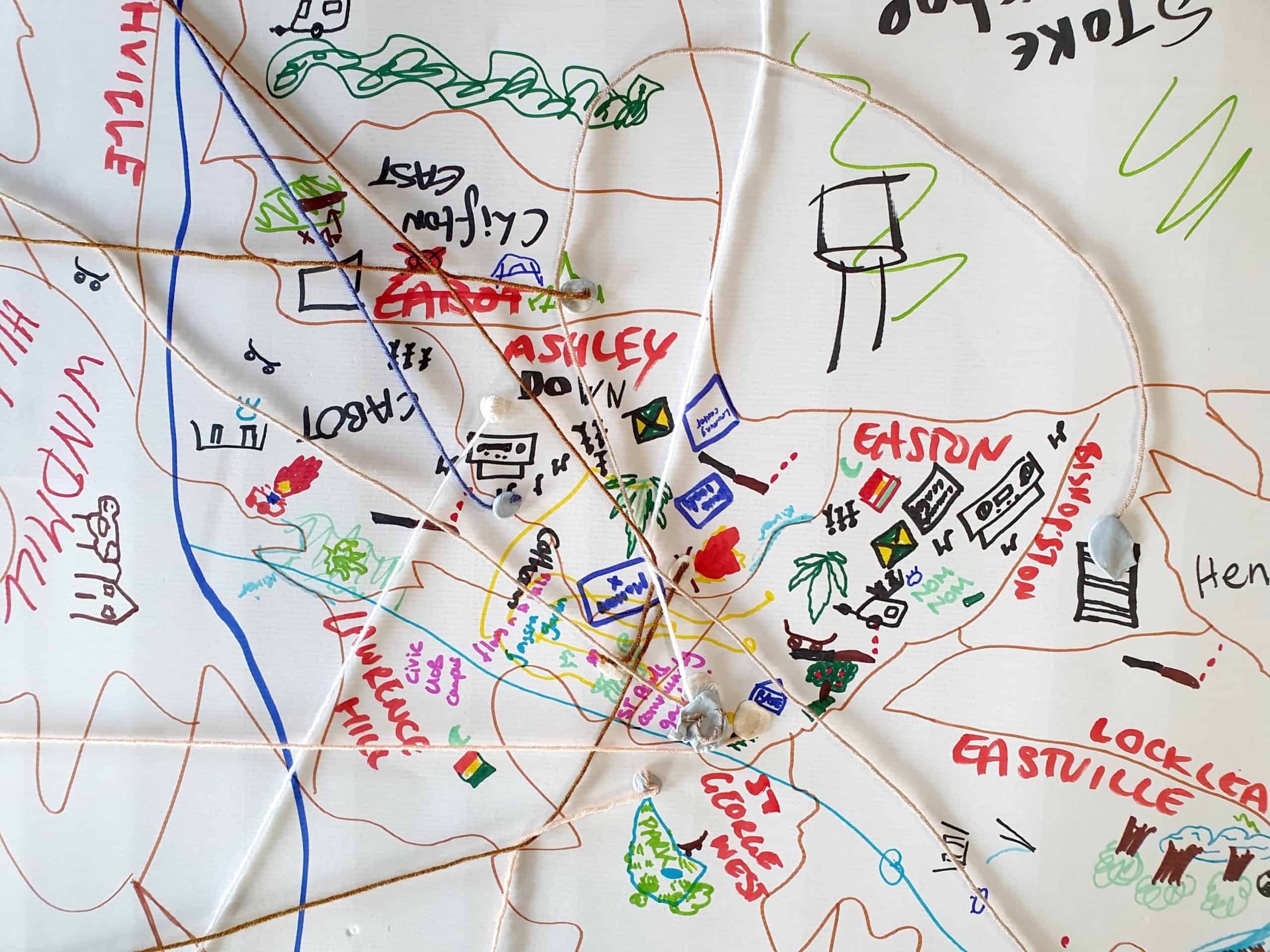

Organising involves building relationships across differences, and differences can surface deep feelings of discomfort in all of us. But what can we learn from those feelings? And how do our varied experiences of privilege and oppression change the foundations of these discomforts – as well as the steps we can take to shift them?
Before EtM came together, I’d co-developed an outreach workshop in an activist group I was a part of around confronting our own feelings of discomfort, as organisers trying to build power in communities that aren’t our own. Grounded in a loosely somatic framework, it aimed to get a bunch of what we might call ‘Capital A activists’ (think: black hoodies, university degrees, DIY haircuts and anti-capitalist politics) to notice when their bodies were telling them something important about a situation they found difficult around connecting with working class and multiracial communities.
This workshop had emerged from a few experiences. A notable one had involved a local housing group, made up of mostly middle-class activists, spending over a year thinking through their outreach strategy for the area that most of them lived in. There had been research into multiple deprivation indexes, spreadsheets detailing the range of community organisations based there, documents upon documents outlining the pros and cons of different targeted approaches to reach ‘the right people.’ And lots of meetings.
What hadn’t happened in that time was much in the way of conversations with others who lived there and who might be facing housing issues. I remember being deeply confused at the time – many capable, intelligent people, with broadly solid politics – seemed unable to do the most basic things to connect with others in their local area. What was getting in the way here?
A couple of years later, I got a hunch. The block was not due to lack of information, capacity limits, or anything else that it might have been easiest to attribute it to. It was deeper than that. The space of strategy documents was safe and familiar to this group. It echoed the formal education many of them had received and even more basically, a kind of polite debate etiquette that many had likely grown up immersed in.
In contrast, the actual communities that surrounded them – in council blocks, barber shops, nail bars and nationality-themed social clubs – were a world apart from these realities. To walk into many of these places would involve the discomfort of stepping into a world not their own. But rather than get out on the street and face the awkwardness, it seemed that an unspoken consensus had been reached to avoid leaving a shared comfort zone and to stay in the land of spreadsheets and hypothetical debates.
At the time, I was wildly frustrated by this experience, but retrospectively, I managed to connect it into some of my own experiences in communities. While some differences were ones I’d found easy to cross in my life and my organising, others had felt like pulling teeth. However low the stakes might have actually been in, say, walking into a Ghanaian barbershop in North London as a two-metre tall white guy with a North American accent, it always took an extra bit of something to face the looks and initial discomforts that often followed me crossing the tracks into a space that clearly wasn’t made for me. Was there much in the way of real risk involved in walking through that doorway? Of course not. But the feeling was still a real one.
My retrospective hunch was that this housing group – and many other activist groups I’d been connected with over the years – would struggle to get out and build the relationships they needed to in a local area, without pointing their investigations towards a more personal set of barriers, than which estate was more deprived, or which community organisations should be surveyed first.
“The stories about who we are and how the world works originate in our autonomic state,” writes Deb Dana, a co-founder of The Polyvagal Institute, “…and are then translated by the brain into the beliefs that guide our daily living. The mind narrates what the nervous system knows. Story follows state. Before the brain understands and makes meaning of an experience, the autonomic nervous system has assessed the situation and initiated a response.”
In other words, we might tell ourselves it’s a lack of data that is holding us back from taking an action, when actually our nervous systems feel threatened and our brains are creating narratives to justify what we are feeling in our guts – however connected or disconnected to current realities this gut feeling of threat might be. This framing – along with connection to some of my own moments of ‘outreach paralysis’ – helped me to let go of the judgments and frustrations I’d initially brought to the group described above. We are not encouraged to listen to the information our bodies tell us, and in ignoring it, we miss out on key details that could help us navigate the world differently.
At the time, I got focused on the more privileged dimensions of this dynamic: the more privilege you hold across different identities and life experiences, the less often you are likely to have to step into spaces not built in your own image. It’s not a perfect rule, but it seems to hold true more often than not. Whether you are needing to get groceries, renew a passport, take your kids to school, or see a doctor, you’re most likely going to enter a space designed (historically, or specifically), by wealthy white men. The closer that matches your own identity, the greater the odds that you won’t have to think twice about being there.
The initial workshop plan had focused on creating ‘safe’ experiences of discomfort and encouraging folks to share and hone the techniques that could settle their shaky hands, cold sweats and knotted stomachs. Once our ‘state’ had been addressed, our ‘story’ about it could begin to shift.
The session worked well in a couple of settings, and less well in a couple more. When Dom got involved in EtM, he surfaced another dimension of discomfort that I hadn’t been able to hold, and forced a significant rethink of the workshop.
Discomfort and awkwardness are often very grounded in context and position. Because of the groups I was in or was working with at the time, I was very focused on the more privileged positions of many organisers coming from ‘Activist’ backgrounds (see: ‘If this is how we think change happens, what does that mean?’). I was seeing how unconscious expectations of being the dominant group in most part of life, made it far harder for middle-class organisers to put themselves in positions to build new relationships across differences, without facing significant internal blocks. And while awkwardness and discomfort may show up for many beyond the middle class organisers I describe, the experiences that fuel those nervous systems responses can be very different, based on different experiences of privilege and oppression.
Dom was quick to point out that the nervous systems responses we might call awkwardness or discomfort, can also be defence mechanisms honed to protect us from real threats, depending on what life has taught us about being in spaces where we aren’t the dominant group. If you’re a working class teenager walking into an entry exam at a Red Brick university, you might feel some of the same feelings a posh Masters student has walking into a Lidl. While at some level, both people’s bodies are doing the same things in these vastly different moments – the level of actual threat is very different across those experiences of privilege.
So while the awkwardness analysis might help some people to check in and reduce their sense of visceral fear of being in a space not their own, it might increase it for others, because the stakes involved in that experience of difference may be so much higher.
All of which meant changing the shape of the workshop, to reflect these polarised experiences of discomfort and awkwardness. We’ve done a couple iterations of it now, and we’re still learning, but the underpinning somatic description still feels like it’s been an important insight: moving into spaces that we don’t feel like we belong can unsettle us on deep levels. Whether that challenge is grounded in a life lived predominantly in a world built in our own image, or the challenge of real violence that comes from experiences of being forced into other people’s spaces, changes how we might best respond to it. But in both situations, there is something to explore, as regardless of our backgrounds and positions, if we want to organise in almost any community, we will have to face those differences at some point. But as is often the case, those who have had to spend their lives operating outside of their comfort zones, are more likely to have developed the skill sets to do so, than those who have been more insulated from it.